Wednesday, 8 June 2016

Patons and Baldwins archive part three - 1930's swimsuits

I've been saving these photos for a while, waiting for the sun to shine for long enough that I feel up to talking about swimwear. As the past few days have been scorchers and humid beyond belief, and I have been wishing that I could spend 24 hours a day floating about in very cold water, it seems to me that now is as good a time as any!

I have shown two lots of 1930's knitting patterns from the Patons and Baldwins archive here and here and explained how I came to see them. I grouped all the swimwear patterns together as it is a great way to see the variety in designs. In the 1930's swimwear became more like swimwear of modern times in that things like long sleeves and bloomers disappeared, bodies are no longer completely covered and the garments are more practical for swimming and more revealing for sun bathing.


The back is very low in many of these swimsuits, reminiscent of 1930's evening gowns. I assume the central strap helps give a bit more structure when actually swimming.


This is a nice two tone example, the way the dark colour carries on in a little diamond into the lighter colour is a nice touch.


I like the effect the stripe wool at the sides gives, it would give an illusion of a smaller waist.


I really like the little sun cape that goes with this swimsuit. It appears to attach by two buttons near the waist to make it easy to add and remove.


I like the harlequin top on this one. She must be serious about swimming as she has a bathing cap.


I was pleased to find some patterns for men's costumes, notice the large cutouts at the sides. The stripey yarn was obviously that year's trend!


This looks very similar to the first pattern, except that she is posing on a diving board.


I was also pleased to find children's swimsuits. This one looks lovely in the striped yarn.


I am assuming this is a crossover strap version of the previous costume


Looks like the side cutouts are slightly smaller on this one.


Never mind the costume, checkout the beach shoes!


Diagonal stripes were popular on 1930's knitwear.


Geometric patterns were also popular.

Do you have a favourite?

There are many, many garments on my to knit list, which, incidentally, never decreases and is regularly added to. Some of them are for me, some are possibilities for my Easy shop, some are commissions and some are just things that I want to knit out of curiosity, just to see what they would be like. Swimwear and underwear are the two main types of pattern that fit this category and I keep earmarking patterns that I will get around to trying one day.

So, luckily for me, Helen from Pretty Old Patterns has decided to run a vintage swimwear knit along. Hooray! This gives me a push to try out one of my patterns! Helen has made three patterns available if you want to try one or it is fine to use one of your own. You can read more about the knit along to help you decide if you wish to join in here.

Tuesday, 31 May 2016

Vintage wedding photographs part five

It is an exciting time as my sister gets married on Saturday. It seems to have been a while in the planning and is now suddenly here. Her dress is made, the cakes are iced, my niece and I have sparkly bridesmaid's shoes to wear, bunting is being put together, paper flowers are being fashioned and crochet floral table centrepiece production is a go go. It is all set to be a wonderful day.

All this wedding preparation made me think it was about time to feature some more vintage wedding photos here. You can find more in my previous posts on this subject herehereherehere  here and here.


I really like this 1920's photograph as you can see a fair bit of detail of the bride's cap and veil. Look at the lovely lace on the corner of the veil that is hanging over the chair. Her cap is either beaded or she has some kind of tiara on. It is a shame that her massive bouquet hides her dress but this is common in wedding photos of this era.


I think this is a 1920's wedding because of the bride's hat, hair and dropped waist dress. On the back of the photo it says Mother and Dad. I wish we had their names! I like the fact that this bride's bouquet almost touches the floor! The groom is very dapper.


I think that this is also a 1920's wedding, although it could be early 1930's. Massive bouquets, floor length veil, pearls, bridal cap. I am particularly interested in the bridesmaid's dresses as it looks like they have some sort of open, full length coat that goes over their dresses. Their hats are also interesting, the look like they have an inner cap that fits close to the head and then the outer part has the brim. You can see the hat pin on the bridesmaid on the left.


I like these two smiley, happy bridesmaids. I like the jaunty angled brims on their hats too. The sleeves and length of their gowns make me think this is a 1930's photo.


I think this is an early 1940's photograph judging by the hair and the woman on the right's dress and hat. We can't see much of the bride but close up it is possible to distinguish two layers to her dress, the top layer is see through and looks to have a lattice pattern. The bridesmaid's dresses look a little more 1930's with their puffed sleeves. On the bridesmaid on the left you can see some kind of detailing near the bottom of the dress, I think it could be an appliqué bow? The little girl has nice shoes that I would wear now and a great, sticking out dress!


This photo is not in great condition but I wanted to include it as the bride is in the middle of laughing at something and looks so very happy. I can't tell if the bride's dress is a printed fabric, some kind of damask or has a lace overlay. Her sleeves look slightly puffed but then tight from the elbow down. You can just catch a glimpse of her floor length veil behind the groom's leg. I like his pin striped suit. I think this is a 1940's wedding.


This is a lovely picture of a wartime wedding. I hope that they had a long and happy life together. The bride and bridesmaid have suits on or possibly the bride has a long coat and a dress on. Impressive hats too.


Very helpfully there is lots of information on the back of this picture. The wedding of Mary and Alan took place on 4th November 1948. The best man is Brian Temperley and the bridesmaid is May Lyons, the bride worked with her at the Regal Cinema. I love being able to find out this kind of information. The bride is in a lovely shaped suit, it looks like the skirt may button down the middle, or it has some kind of central decoration. May's dress has some very pretty pleats and looks to have some embroidery at the collar. She has a very far away look!


This bride is wearing a lovely suit, it is probably a wartime wedding. The star piece of her ensemble is her hat. It  has masses of veiling and some bird's feathers/wings/half a bird on it. Quite impressive. They look happy couple.


I think that this could be a 1940's wedding too. The top of her dress has such beautiful details on it, beaded flowers and a sequined ribbon. I think that her hat is made of feathers, I like the ones that curl around her ears. This is a lovely, happy picture.


This is such a fabulous picture of these three bridesmaids all smiling away. The have lovely floor length floral dresses with a slight sweetheart neckline finished off with pearls. They all have elbow length white gloves and cute half hats. I think this is from a 1950's wedding.

I'm looking forward to Saturday!


Sunday, 20 March 2016

Irish crochet

Irish crochet collar
On Thursday I spent a lovely evening visiting the Huddersfield branch of the Knitting and Crochet Guild for their monthly meeting. This month the topic was Irish crochet, something that I knew very little about. I was looking forward to learning more about it and excited to see some samples of work.

Some of the photos are a little shadowy, I was taking them with my phone camera, standing around a table with several others, casting our shadows all over the place. All the pieces are very delicate and have to be handled wearing cotton gloves so you can't mess about with them too much just to get a perfect photo!


Irish crochet developed in the early 1800s in rural Ireland which, at this time, was poverty stricken. The crochet was done in people's homes and sold as a way to make an income. This was especially true during the Potato Famine. The Ursuline nuns taught women and girls the skills they needed as they recognised that women needed a way to make an income.

These are the tools of the trade, very fine cotton or linen thread and crochet hooks with a hook so tiny that it is very difficult to see.


This is the first piece of work that was shown to us. It is an open coat/gown and we all thought it was very fine, until we saw the next few pieces which showed what really fine work actually looked like!

Irish crochet consists of motifs, like the bunch of grapes which you can see at the bottom centre of the above picture, which are then connected together by a mesh or net to form lace. The motifs may be made by many different people, collated and then joined together to form a garment.

Apparently, families kept close guard of their motif patterns, making sure that any crochet work was out of sight when visitors called!

Irish crochet differs from traditional crochet which is usually formed of rows or rounds.


This is an old and delicate pattern book. The front section explains how to make the motifs and gives some patterns for them. The back consists of patterns which fold out, showing how to put the motifs together to make the collar, cuffs, jabot, trims etc that are desired.


This is a photograph from inside the book of a cuff and collar set.


This is the pattern layout for the set, showing the motifs that is is made up of. The motifs would be stitched to the pattern and the spaces in-between filled with very fine crochet mesh. The finished item is then removed from the paper.


This is it in close up so that the intricate detail is clear.


This is the cuff pattern. You can see that it is simpler but is made of the same motifs as the collar.


This is probably a cuff, not the same as the pattern above. This is such a fine piece of work, look at the tiny bunches of grapes.


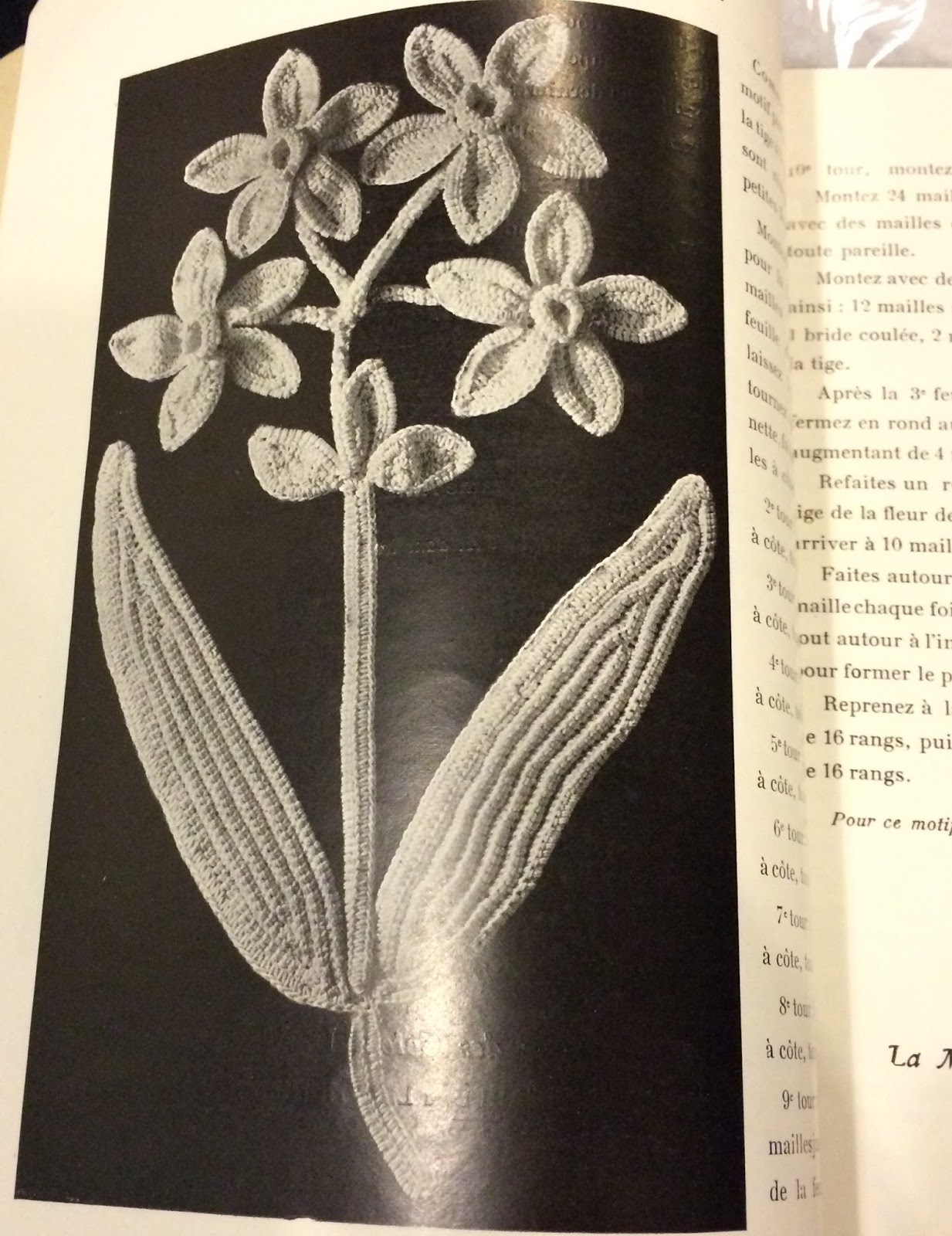
I enjoyed looking through this delicate French pattern book as it had lots of amazing motifs in it.


This pretty butterfly.


These lovely cyclamen.


Fabulous tennis rackets with tennis balls. I can see this on a 1920's or '30's tennis dress or cardigan.


Perfect for Spring daffodils.


There was also the pattern for this little chap, he is on a very pretty blouse. 


This piece is made up of floral motifs.


Some more examples.


This is a very fine bag with a drawstring top. You can see a central rose, a rose is a very traditional motif, surrounded by a floral design. Leaves, flowers and shamrocks are other traditional motifs.


This is a child's dress which has both inserts and trims of Irish crochet. The work is so incredibly fine.


The insert features the rose motif. Spot the lizard again!


This is a close up of the trim. When you stop to think of the conditions under which this work was created it becomes even more special and incredible. The makers of this work were poor, hungry, cold, worked in bad light and in unsatisfactory conditions.


Another child's dress with a deep edging of Irish crochet.


The cuffs and hem all end in this gorgeous bobble edging.


Bobbles and roses.


You can see how fine the mesh is between the motifs.


This is another view of the blouse that has the lizard on. It was felt that the lizard was a later addition to the original crochet fabric of the blouse.

I ended the evening being really amazed at the level of work and skill in these garments. In the 1900's   the Irish crochet industry declined as it could not compete with the speed and cost of machine made lace.

You can read more about Irish crochet, see more examples and find instructions to have a go at it yourself herehere and here. I think I would like to have a go and see if I can just make one, very very simple motif!