Showing posts with label embroidery. Show all posts

Saturday, 24 May 2014

Handmade 1930's sportswear for women

I was looking through some of my 1930's 'The Needlewoman' magazines to do some research for my second birthday blog post and my eye kept getting caught by images of sportswear. I kept seeing lovely hand knitted jumpers and then seeing the props in the photos were tennis racquets and golf clubs and could see a theme emerging and feel another post coming on. So here is a little tour of 1930's women's sportswear.

Tennis seemed to be the most popular sport if judged by how many times tennis outfit were featured.

'Tennis days are here again'
From the June 1934 issue. Here is the lovely, evocative description from the magazine:

'Now that the long, light evenings are back again, everybody is on the tennis courts getting ready for the summer tournaments, and smart "woolies" are by no means the least important item of equipment. The jumper shown above has two essentially practical features - the short, capelet sleeves, which leave the arms gloriously free to serve and smash and volley, and the deep, tight fitting basque which prevents the jumper from "riding up" with every movement. The jumper is knitted in a pretty fancy stitch in white, with narrow ribbed edgings of scarlet'.

It makes me wish that I could play tennis just so that I could wear it.

The next few pictures are from the same issue. This coat is stunning.

'Tennis woolies are so smart'
'To be fashionable you must knit odd sleeves and only half belts and collars to your smartest coats this year! The coat is correct for tennis or informal wear at the seaside on summer evenings, while, completed with a little red beret to match, it would look smart for walking. The neck and coat fasten with large triangular buttons, allowing the white tennis frock to show above and bellow the belt fastening'.

I love the idea of adding a red beret to make it a walking set. It puts my walking clothes firmly to shame!

A dress motif for a tennis player
'This motif has been sketched on the cape collar of a tennis frock in white or cream silk. The motif could be worked on any tennis frock, blouse or jumper and would look particularly smart on a beret or scarf'.

'A coat of arms for the tennis player!'
' "Five tennis racquets rampant over afield of tennis net" is how this jolly little "Coat of Arms" might be described in heraldic language - with apologies to the College of Heraldry! Every sportswoman likes to have a touch of embroidery on her sports clothes and this little motif, amusingly arranged in the form of a "Coat of Arms" will give a smart, exclusive air to tennis blazers and frocks'.

'The "Coat of Arms" is shown here on a
regulation sports blazer'.
'Made in white or cream flannel, with the embroidered motif and gilt or steel buttons, such a smart, businesslike blazer would not disgrace the centre court at Wimbledon! This same motif could well be adopted by a tennis club or team as its own particular badge, by working it in club or school colours and adding the necessary initials'.

The magazine suggests the following colours - Greys, Apple Green, Light Rose, Light Madder Pink, Light Electric Blue, Ochre Yellow, Light Periwinkle Blue. I always enjoy it when magazines with black and white illustrations do this as it gives a clearer sense of what the designer was imagining. I also love to read the names of the colours.

The next two jumpers are from the July 1934 issue.

'A waistcoat Pull-over for sport or town wear'.
'A smart Pull-over in white knitted in an attractive pattern of broken diagonal lines. The front opens like a waist-coat down to the ribbed basque, and it is fastened with scarlet wooden buttons. The Pull-over is planned for the slightly-larger-than-average figure and allows ample room for movement without becoming disarranged'.

You might be interested to know that the larger than average size referred to is a 36" bust! I really like the stitch pattern and the buttons and red and white for tennis must have been a trend that year!

'A useful jumper for tennis and holiday wear'.
'Here is something novel and attractive which will appeal to the busy woman - a jumper which can be knitted over a weekend! Thick, 6-ply wool, big needles and a very simple design make this possible. It is a most attractive model, too, and will look smart for tennis or holiday wear since it is in the fashionable cable stitch. This is cable stitch with a difference, though, since only one stitch comes between each cable twist and this is dropped when the top of the work is reached, to give the pretty openwork ladder effect which makes the jumper look so "summery" and unusual. A little tab of scarlet corded ribbon gives a chic finish.

I think this is lovely, the construction sounds very interesting.

Now to March 1939.

A LUX advert
The text says: 'If you have been to Wimbledon, you've seen little coats like this one worn by many of the tennis stars. They play in them when it's cold. Or they throw them round their shoulders as protection after the game. This particular model is the nicest of its kind, with clever groups of cabling, a neat, high neck and a flatter-your-figure fit. Given good care, this coatee should last for several seasons without showing its age. Good care, of course, means LUX. Pure, gentle, best for wool LUX.'

LUX advert close up
Readers of the magazine were able to obtain free instructions for knitting this garment by sending the top of a 6d Lux packet to Lever Brothers Ltd. I wonder who designed the knitwear for them?

Next we are looking golf clothing which seems to be the second most popular after tennis. These next images are from the September 1934 issue.

'For golf or smart country wear'
This jumper is knitted in a brownish red wool. I think it is so smart and I like the way the ribbed yoke extends part way down the sleeves.

'On the golf course, or, in fact, for any sports wear, you will find this the most practical and comfortable garment - there is nothing to get out of place or disarranged. Worn either as a jumper or a cardigan it fits snugly to the figure and may be buttoned right up to the neck or turned back in small revers, if the last two or three buttons are left undone. Knitted in a lighter shade, it would be perfect for Autumn and Winter tennis. The shoulder yoke at the back and front is worked in a pretty twisted rib and the little patch pockets (such a boon to golfers for tees and tennis players for that elusive hankie!) add a smart and businesslike touch.'

'On the banks and braes o' bonnie Scotland'
Aren't the colours in this image just glorious? It is interesting that in the following description it describes the neck line as a new style. I rather fancy this outfit, perhaps without the golf club!

'Long days on the Scottish moors - shooting, fishing, playing golf - and here is just the jumper you will need. It is designed for comfort, with the new loose fitting circular neck which is fastened at the back with three buttons. The stocking stitch and ribbing in which it is knitted are light and yet close enough to keep out the first chill of autumn, while the serviceable pockets add a smart touch to this essentially sporting model'.

Moving on to January 1936.

'A "Lighning" fastened woollen jumper gives
warmth for winter'
This is knitted in rust coloured wool.

'Whether it is for vigorous golf, for walk or for "spectator sporting" a girl would be hard put to find a more trimly attractive jumper than this. The knitting is done in 3-ply knitting wool, fastened with an 18 inch long Lightning fastener which gives a smooth, neat finish, and ensures protection against the cold. Note the youthful little turn down collar and the very attractive stitch used in the knitting'.

In the September 1937 issue there is this jumper:

'A "tweedy" knitted golf sweater'
'This extremely good sports jersey is knitted in a new wool that gives the effect of tweed. Plain wool in rust to match the flecks in the tweed wool is used for the collar and pocket top. The collar is cleverly designed to form both vestee and roll collar, and gives a very becoming neck line'.

Having covered tennis and golf we will take a look at a couple of other sports. Firstly, swimming in July 1938:

'Knit this for your August holiday outfit'
'Bathing suit with detachable skirt'
Isn't this just fabulous? I love all the little details. This one is knitted in brown with yellow accents.

'This neat model features everything that could be desired in a bathing suit - well shaped, beautifully fitting, and equipped with a detachable skirt'.

In December 1937 we get an ice skating outfit which is made using crochet.

LUX advert
'It's the newest style to wear on the ice - this clever adaptation of the popular bolero. Note the loose back which swings out gracefully in motion and the bands of gay colour at the edge. Made with well fitted wide shoulders, and neat small collar, you can wear the bolero loose over your skating frock or, snugly fastened, with a skirt alone. Cunning little Juliet cap to match'.

I like the fact that you are given styling advice. Again, this pattern was available if a Lux box top was sent off.

From July 1938:

In colour on the cover
'For your holidays'
This is such a cute versatile jumper and I like the colourway.

'For tramping, sailing, tennis and more active pursuits'.

From September 1938:

In colour on the cover
'yellow boucle jumper'
'Choose yellow boucle for this youthfully simple jumper - splendid for sports and country wear'. This is so pretty and smart, really well shaped ribbed body and an interestingly patterned yoke.

So, lots to choose from for our sporting activities. Any catch your eye?

Friday, 7 December 2012

Handmade wedding - the cake.

So, this is all about the cake. The actual cake. The edible cake. The square or round cake. The tiers or separate cakes cake. The two or three tier cake. The save the top tier or not cake. The get a chunk on the night and lots to keep afterwards cake. The lets have lots of photographs of it being cut cake. The goodness how big is the cake knife cake. The do not make me pretend to cut this cake anymore cake.The takes two grown men to lift it when I decide to change the tablecloth cake. The please do not drop it cake. The let us hope it is cooked cake. The does it taste nice cake. The oh is it not chocolate small child disappointed cake. The do we have a big enough tin for the leftovers cake.The no knitting involved cake (well, in the decorations, there had to be a little bit!). The how beautiful is that cake cake.


Some decisions about the cake were very easy to make. We knew we wanted to have fruit cake with marzipan and icing. We knew we wanted three tiers. We knew that we were not going to buy it. I was all prepared to get making when I received some wonderful offers of help from my mum, my sister and my very creative friend. As very creative friend is artistic and has done a cake decorating course she was elected chief of cake and was put in charge.

My mum made the bottom layer and my sister made the middle layer, they marzipaned and iced them. The bottom layer took 12 hours to cook! Very creative friend made the top layer, the decorations, assembled the tiers and made an extra cake that I could take along to my knitting group. Big thanks to them all.


Each tier had navy grosgrain ribbon placed around it which was then decorated with knitted flowers. All I had managed to specify was that I wanted flowers in autumnal colours and I was amazed with what I got. I can not tell you how to knit the flowers as the pattern is very creative friends but you could use a pattern from the book mentioned in a previous post or just experiment and make one up. All the flowers had button centres and some had ribbon added too which gave a really lovely effect.


The flower placement on each tier was staggered which showed off all the flowers in their glory and also made it look a little less formal which was in keeping with the mood of our wedding. We decided that we wanted to keep the look quite simple so had matching flowers on the top of the cake.

Here you can see a close up of the flowers and a little bit of detail of the cake stand. It was an ornate silver 1920s cake stand which was totally gorgeous, I loved it. It was hired from the local bakers, what an object to own!


I wanted the cake to be on an embroidered tablecloth for several reasons. I love them and collect them. I like to imagine people sat in their living room embroidering little sections day by day. I like to think who those people may have been, who they were making it for, why they choose to use that particular transfer or that combination of colours. I like to look at the needlework and imagine someone making those stitches. I do not even mind if they have the odd stain as I wonder what it was and hope that they were having a good meal when it happened.

They also remind me of my grandma. She had a few such tablecloths that used to sometimes come out at tea time. There was always a chocolate cake on a cake plate and very often jelly in a big glass bowl. Grandma had a crinoline lady tablecloth which was my favourite. I have it now and pick up others when I see them. Sometimes we used the crinoline lady china set at the same time. My sister has that. The tablecloth used was not Grandmas as I did not want to worry about it on my wedding day. But I know she would have approved and it was a way of having her there in spirit.

If anyone knows why there seemed to be a crinoline lady obsession on tablecloths, napkins and china in the 1930s and 1940s do let me know.


One great thing about having three people each making one layer of the cake is that every layer is a different recipe. They all taste marvellous but not the same with variations in fruit, amount of fruit, type of sugar and type of alcohol used to soak the fruit or to feed the cake. We are enjoying having a cake to cut at and offer to guests. It is like a little piece of wedding joy every time.

Thursday, 30 August 2012

Vintage haberdashery adverts.

As well as the glorious patterns for all manner of crafts in my old magazines I also really enjoy looking at the adverts. I could talk about all manner of adverts, those for reducing (in size), tampons (as they developed), custard, shoes or bleach. Perhaps one day I will as they are a fascinating insight into the way people lived, product development and the gradual evolution of ideas and ideals. Because my latest magazine haul was Needlewoman and Needlecraft I want to focus on haberdashery adverts as, obviously, that is the most fitting product to advertise in that type of magazine. Plus, I love haberdashery. It is pretty, its is functional, it is interesting and most of all it is full of potential; just waiting for you to come along, make a choice and produce something gorgeous with it.

It is worth taking a look at the Woolworth's Museum site (random I know), for its 1950s haberdashery displays http://www.woolworthsmuseum.co.uk/1950s-i-woolhaby.htm . Woolworths stores all had a large haberdashery department selling buttons, wool, knitting and sewing patterns. The site has pictures of these plus pictures of store windows showing a display for wool week or for making do and mending.

I think this is brilliant. The bonkers curtains, the lovely
colours, the shapes, her beautiful dress and hair.

I like Anchor adverts. Great colours again and a fancy
cross stitch tablecloth is always good.

I'm not convinced that she would do her own mending
but she does lend an air of glamour to the proceedings.

Same with her, I think the wonderful hair and make-up
would not leave enough time to personalise her dainties
with embroidery. I think a maid is lurking in the background.

What a fabulous display of threads. Spoilt for choice!

Janet, Alison and Enid. All three of them give great jumper.
And hair.
Enid is 'striking the happy medium between primness and
frivolity'.
Alison is 'all for cosiness so this long sleeved style is more
suitable for me'.
Janet says ' how do you like the bright little idea I'm wearing
now?'

Wool snake. Wool snake charmer. Magic carpet.
Great colours. Can't beat it!

Showing you the 'smartest ways of using the best bias
binding of all'.

I would like to think that she is called Melody as well
as the wool. I love the cardi, I'm not sure I will ever
have the patience to make it.

'These little folk are happy all day long, at the seaside,
in bathing suits of Crocus wool. They are warm and
comfortable and do not shrink or loose their shape'.

Featuring a' backless suit for sunbathers, a fancy
pattern for two bright colours and knickers and
a brassiere to make a novel two piece bathing suit'.

Colour. Beautiful.

Good to have a reliable zip for all situations.

Excellent. Women can crochet and be intelligent. Quite
progressive.

Little boxes of colourful delights.

Anchor had to feature an anchor at some point really.

I agree that the women have glamour.
The thread though?

Lovely embroidered tea cosy.

Nice to see how the transfer and stitching work.

I realised that I have had my own small connection to haberdashery for many years as I went to school in London at Haberdashers' Aske's Hatcham Girl's School. It was the longest name of a school in the country at the time but it has changed name now. Whilst it sounds ever so posh it wasn't at all, the name is due to the founder of the school, a Robert Aske, who was a Haberdasher. In 1689 he died and left £20,000 to the Worshipful Company of Haberdashers (of which he was a member), to buy land and build a school. The Haberdashers were founded in medieval times by a group of traders who all lived in the same place in London and all worshipped at St. Paul's Cathedral. They sold ribbons, pins, gloves, purses and beads and were joined by the Hatmakers in 1502. They were like the trading standards of the day in charge of checking quality, training apprentices and setting wages amongst other things. They controlled the haberdashery trade in London until 1650 when the population of London grew too large for it to be practical. They now exist as a City of London Livery Company and concentrate on education and charity work.

Monday, 27 August 2012

Latest vintage magazine finds.

When I go out and about I am always on the lookout for charity shops, antique centres, vintage fairs and quirky little places where I might find some treasure! Most often I look on my own as the people I am with tend not to have the same capacity or desire to sift through piles of 'junk' - as they see it! So each to their own, I have a very happy time! In the Lake District last week I stumbled across a mini treasure trove. I expected my week to be full of walking, looking at beautiful mountains and trying various tea and cake establishments. All of that happened too, but the randomness of my find added to the delight of finding it! I think I let out a little squeal when I found a pile of Needlewoman magazines from the 1930s and some Needlewoman and Needlecraft magazines from the 1950s.

I love old craft magazines for a variety of reasons. Obviously they are a marvellous source of patterns for garments from past eras. Most of them have knitting patterns and I have found some beautiful jumpers and cardigans to put on my list of things to make. I like seeing the ideas for household items, it gives a real sense of what a period home would have looked like. Sometimes I am amazed at the array of embroidered tablecloths, chair backs, table runners, place mats, napkins, stools, firescreens and pictures. I wonder how anyone had time to produce such things. I enjoy the physical feel of something old in my hands. I like to think about the previous owner - what did they make out of it?, what did they wear?, where did they live?, what was their house like?, what have they lived through? I particularly like the connection that is made when the magazine has a surname and address on the back, for a subscription delivery.

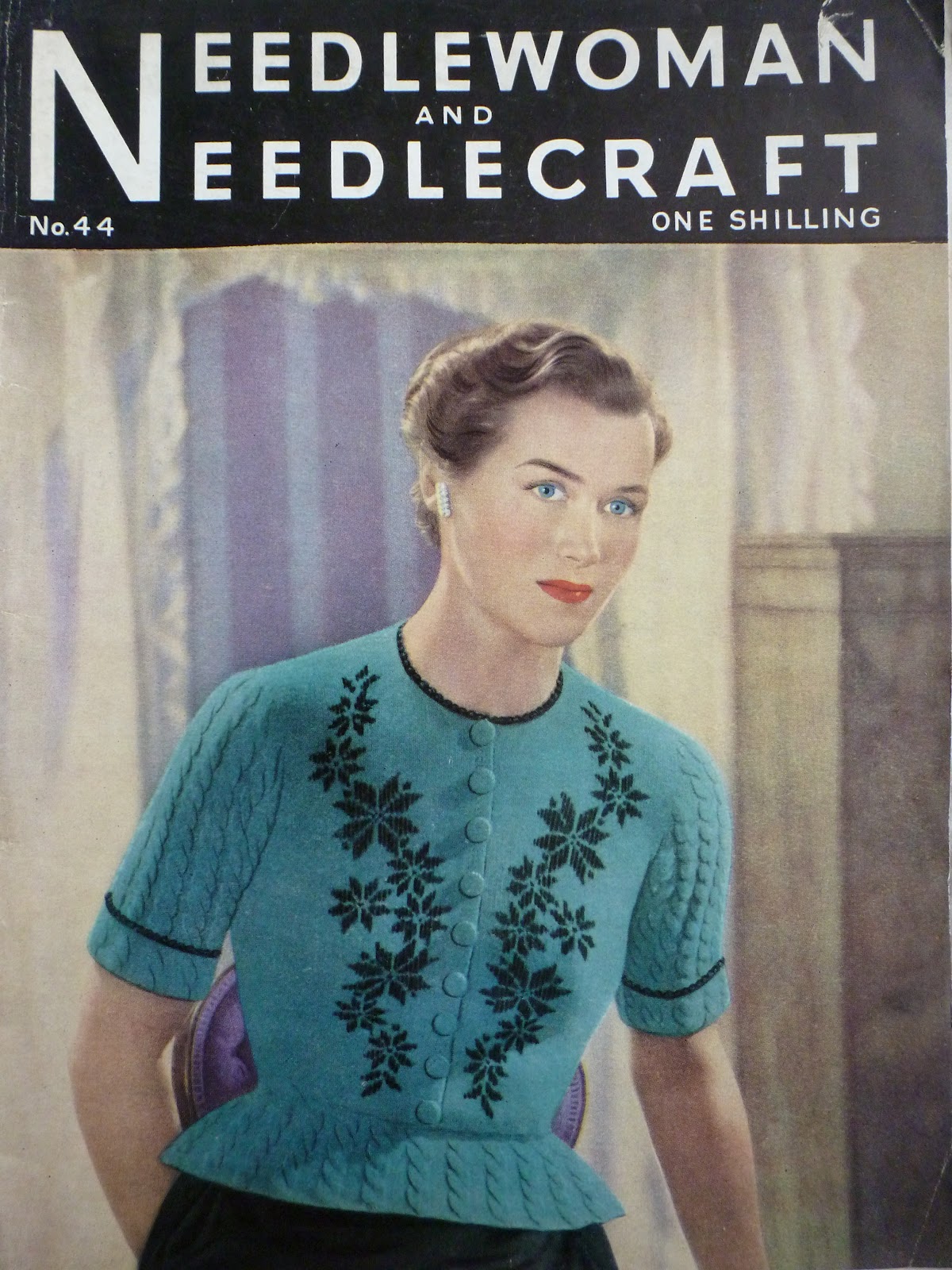
The following pictures are of the front cover of each of the magazines, starting with the oldest. From these alone I think that you get a real feel for the wealth of needlecraft projects contained within, from embroidery to crochet to tapestry to knitting to cross stitch to applique.

Highlights the free transfer available in this issue,
featuring 'four lovely little flower sprays arranged in a
surrounding border of single Forget-Me-Not
flowers'. The suggested use is for a drawing room or
boudoir blotter cover.

This cover features the design for a cushion that
is part of a garden tea set. Other ideas in the set are
a firescreen, a pouffe, a tea cosy, a chair back and
a table runner.

A bowl or roses in cross stitch - 'a beautiful theme in
a favourite stitch, rich and luxurious to behold'.

An embroidered wall panel.

An applique market scene.

The most beautiful cable and fair isle peplum jumper.

An applique bowl full of silk embroidered anemones.

'Like all good traditional designs, Jacobean embroidery is
very pleasing to every generation and it is perfectly
suitable in our modern home'.

A firescreen featuring a 'distinctive design with a quiet
blending of colour reminiscent of the English designs
of the Regency period'.

An autumnal luncheon set of six, featuring oak, elm,
mountain ash, beech, chestnut and sycamore leaves.

An embroidered Kentish scene.

Cross stitch design for chair and settee backs.

Embroidered spring posy tablecloth.

Alpine beauty picture - to 'retain your happy holiday
memories'.
These magazines have an interesting background. Needlecraft was first published in 1904 by Manchester School of Embroidery. In October 1907 it had a change of title to Needlecraft Practical Journal. In 1940 this title amalgamated with The Needlewoman magazine. This had been running since 1919 and continued until 1940. At this point the title became Needlewoman and Needlecraft. It changed back to Needlewoman in 1970 and then was incorporated into Stitchcraft magazine in 1977. Throughout all its name changes the magazine continued to feature a huge array of needlecraft patterns, tips and ideas. The magazines also changed size, particularly during the Second World War to account for paper shortages.