Showing posts with label couture. Show all posts

Wednesday, 27 March 2013

1950s couture patterns by post.

I have been thinking about couture frocks for a while, probably because of the latest round of Fashion Weeks and because of the Hartnell and Amies exhibition that I went to. I am always amazed at the detail, the fabulous embellishments, the embroidery, the beautiful fabrics and the sheer hard work that must go into every dress.

Whilst flicking through some 1950s Woman's Illustrated magazines I was taken by surprise to see that they featured a mail order couture pattern in each issue, by a variety of primarily French designers. I thought it would be interesting to take a look at some of them.


March 20th 1954.
Woman's Illustrated was published by Amalgamated Press and then Fleetway from the late 1940s until the late 1950s. Women's magazines increased in circulation in the 1950s due to the end of paper rationing, an increase in wealth and an increase in advertising. As women were often in control of the family budget, advertisers realised that women's magazines would be a great way to show off their products. Women's magazines became far more important than ever before. In fact, in the 1920s and 1930s they were considered to be insignificant.


The March 20th 1954 magazine features a pattern by Balmain in bust sizes 32-40 ins. In the letter he says:

'I am delighted that you will be able to make my first frock for you this Spring so soon after its appearance in my new collection. It is a very simple little frock of which the main charm lies in the fringe trimming - very feminine and pretty! And you will find it very easy to do.'

The photo of the front cover shows the original Balmain dress. The fringing is described as exquisite drawn thread work and self fringe.


The top picture features the dress without the fringing. The fabrics suggested are Viyella for the most economic choice or pure wool. The illustrated fringing is stocked in Harrods as is the braid. In Viyella and using braid the dress would have cost £3 7s 0d.


I like the fact that accessories are suggested to make it a complete and perfect outfit. The hat is a navy and white sailor hat by Walmar. The shoes are navy and white courts featuring the 'new' two-inch slender heel from Dolcis. White gloves and a navy calfskin bag from D.H.Evans and Co complete the look. If you were to have bought everything for this outfit it would have cost £12 12s 2d.

March 27th 1954.

This issue features a pattern for a suit and blouse in 32-40 ins designed by Norman Hartnell. Much is made in the accompanying text of him being the royal dressmaker. The jacket is boxy with slit pockets, bracelet length set in sleeves with a slit cuff and is lined in material that matches the blouse. The skirt is straight and slim with a long inverted pleat at the front. The blouse is button through with a soft wide neck-tie and has a camisole inside.


The suggested material for the suit is rayon 'alpaca' in grey, navy, grey-blue, pale blue, brown, pink or plum red from Dickens and Jones. They can also supply stripped semi-sheer nylon in shocking pink/white, grey/white and lime green/white. For a brown suit the lime green and white blouse is suggested, I think I would have loved this.

At the top of the page are some tips from Hartnell's tailor Mr Rossi to help the home sewer get the details right. These were taken in the workroom behind Hartnell's salon in Bruton street, London.

June 12th 1954
The pattern in this issue is for a skirt and blouse  32-40 ins designed by Balmain. The idea behind this feature is that Balmain has provided the pattern for a basic trend which has scope to be altered by changing the fabric and styling.

As it says in the text :

"The final choice is yours - we know it will be a good one... You'll look lovely, because you'll look your charming self." 


The spotted version on the left is made in coin dot silk and is called 'For Town' as "silk is an aristocrat with Town manners". The version made in diagonal cotton checks on the right is called 'Country Style'. This is made in pink for the blouse and blue for the skirt, "a colour scheme for someone who's young at heart".


From the left:

'The Young Idea' a crisp white poplin blouse with a contrasting black skirt and a red taffeta cummerbund, "the individual touch of an under twenty Miss".

'Southern Style' a polished cotton skirt with clusters of ivy leaves in wine, pink and grey with a grey blouse. "This is the choice of a girl with warm and vital looks".

'At the Office' a blouse in grey and white gingham stripes, a grey skirt and black accessories with a rose buttonhole. "one career girl steps out looking fresh and lovely".


'Party Pretty' pink and grey sheer floral fabric. "Final touch - pink beads, rows and rows of them".

April 6th 1957
This issue features a dress and a suit 32-40ins designed by Norman Hartnell. These were featured to celebrate the Queen's visit to Paris which she was making the week after this issue came out. There she would be wearing clothes designed by Hartnell. The suit has a fitted jacket and a full skirt with pleats. The suggested fabrics are silk or fine cotton. The dress has a simple, unfussy bodice and a full skirt made in silk.


The suit was originally made in grey and white. The recommended silk from Dickens & Jones has sprays of flowers printed on grey, turquoise, brown or cream. The features highlighted on the suit are as follows:
- wide revers, collar piped in white.
- slim set-in sleeves - 3/4 or full length.
- fitted jacket with short basque.
- flared skirt of pressed or unpressed pleats.


The dress was originally made in black and white. The recommended white polka dot silk from Peter Robinson & Co Ltd comes in green, turquoise, peacock or tan. The features highlighted on the dress are:
- simple slit neckline bound with contrast.
- short sleeves cut in one with bodice and bound with contrast.
- fitted bodice with extended waistline.
- full, gently gathered skirt.

The grey suit and peacock dress for me please!

July 13th 1957

Here is another pattern by Balmain for  a two-piece 32-40 ins.

"Choose a two-piece for mid summer days! It's so easy to adapt for town or country. It's so comfortable to wear for travel or holidays.... The casual two-piece, already a favourite with the young crowd, can be worn just as successfully by any age, and when it is designed by Pierre Balmain - a young-in-heart fashion achieves a Paris finish!"

The pattern above has a semi-fitted middy top and the skirt can be gored or straight. The one in the picture is made in white wool jersey piped in navy. Plain linen or jersey stocked by John Lewis is also recommended, with contrast piping. The main features are:
- face framing revers that are mitred at the corners.
- contrasting piping that edges front band, pockets and cuffs.
- clinging fit of the middy top for ease and comfort.
- swinging line of the twelve gored skirt version.


This version has a double breasted bloused top and a choice of a flared or slim skirt. Plain or printed material is suggested along with an over collar in white pique for "extra sparkle in summer". I like this version with the flared skirt the best but probably in a print rather than plain.

I wish it was still possible to have patterns like these in a weekly magazine. If you are looking for similar patterns Vogue and Butterick have released a number of their vintage patterns re-sized for today's figures.

Friday, 22 February 2013

Hartnell to Amies. Couture by royal appointment exhibition.


Amies.
 Bronze & silver geometric patterned brocade
day dress with decorative fur tippet.
The first dress you see! I love a bit of brocade.

I spent a few days in London recently and went to this amazing exhibition at the Fashion and Textile Museum. It is only on until the 23rd February so if you get a chance to go in the next two days I really would do. It focuses on the timeless elegance of fashionable London couture and the selection of outfits is absolutely stunning. Only a few are behind glass, the rest are on mannequins so you can get quite close up and see all the amazing fine detail.

I thought about writing about the lives of Hartnell and Amies and their influence on couture but then realised that I just want to talk about the beautiful clothes and that others have written huge books on the subject. If you wish to read more about them and the period of couture featured in this exhibition then this book, this book and this book should cover it.


Norman Hartnell

Hardy Amies
I should just say that some of my pictures are a little dark as flash photography was not allowed. I am including the pictures that I think are the best. There are some lovely clothes that I have had to leave out as the lighting and lack of flash did not allow for a good picture. This applies particularly to a gorgeous 1950s black coat embellished with tiny black beads.

I am showing the outfits pretty much in the order that they are laid out in the exhibition so that it will be a little like taking a tour around it yourself. This is why they are not in period order.

There are lots and lots of photographs to come!

Hartnell. 1929.
Embroidered silk satin wedding dress for
Miss Oonagh Guinness.
The picture does not do it justice. It is so, so beautiful.

Close up showing beading round neck, waist and cuffs and
embellished bodice.
Close up of the embellishment on the train.
I can't imagine how much time and patience this work would have taken.


 Hartnell. 1935.
 Evening dress embroidered with
gold palliates.
Worn by HM Queen Mary.

 Close up of bodice. So twinkly!


Amies. 1968.
Hunting, shooting and fishing green tweed suit.
Worn by Lady Delamere.
Check out the knickerbockers!


 Hartnell. 1938.
Black crepe evening dress with matching beaded
bolero jacket.


Close up to show the pink rope twist bead embroidered decoration.
Such a gorgeous dress. One of my favourites.


 Amies. 1940.
Prince of Wales check fine woollen suit.
Worn by Mildred Shay.


The edges of the jacket lapels show the woven selvage stating
Made in England. This adds unusual detail.


 A view of the exhibition staging.


Hartnell. 1947.
A sketch of the wedding gown for  Princess Elizabeth.


 Examples of embellishment.
I love the Christmas cards. You could use these for inspiration for cards or
for making covered notebooks.

1938.
Sequin and feather hats worn by Virginia Cherrill.
I like the colour combination, classic metallic with a
 shot of pink.

I would like to see this on.


 Hartnell. 1930s.
Gold silk dress with large bow.


 Close up of bodice embellishment.
Hours and hours of work here, it is so pretty.


Hartnell. 1945.
Detail of embroidered black silk and velvet coat
with 3/4 sleeves. Known as the Jewel Coat.
Not to my taste but magnificent all the same.


 Amies. 1962.
Abstract white leaf printed blue silk day ensemble
of sleeveless dress and long sleeved loose coat.
Another favourite! I need a day ensemble!


Foreground - Amies 1950.
Blue and grey fine tweed suit with blue velvet collar
and slant flaps to pockets.

Background - Hartnell 1959.
Ribbed taupe and grey suit with a velvet collar.
These make me want a suit even though I have no need
of one.


Hartnell. 1956.
Blue crepe two piece suit with blue and white polka
dot detail. So lovely yet so simple.


 Hartnell. 1957.
Black and white printed silk three piece suit
with blouse top.
I like the cut and drape of this.


Hartnell. 1932.
Pale celadon bias gut gown.
So elegant!
Full length view of the Jewel Coat in the background.


 Love, love, love.


 Amies. 1960.
Dark red and black printed, glazed man made satin
cocktail dress. Boat shaped neck, fitted bodice,
3/4 sleeves and a full skirt.
I need this dress.


Amies. 1952.
Copper satin strapless cocktail dress with a fitted
bodice and a full reinforced skirt with wide pleats.
Love the colour!


 Hartnell. 1952.
Chartreuse beaded evening dress.
The photo does not do the colour justice. It is a truly
stunning dress. I want it alot.


Close up of the incredibly detailed beading.


Lovely grey beaded evening gown.
I don't seem to have written down who this is by
but it is too pretty to leave out.

 Close up of the bodice beading.


 Background. Amies. 1950.
Ivory silk evening dress with a fitted bodice, sweetheart
neckline and an open back to a full skirt with draped
panel decoration.

Foreground. Amies. 1981.
Cream silk taffeta wedding dress with long sleeves.
It has a draped bustle effect held by bunches of white
roses. Worn by  the Duchess of Buccleuch.


 Bodice detail.


 Hartnell. 1959.
Embroidered crystal bead vermicelli pattern grosgrain white
evening dress.


Close up of beading on bodice.
Look at all that work!


Hartnell. 1956.
Satin organza wedding dress worn by Lady Anne Coke.


 Close up of the silver corded lace bodice.
How gorgeous!


Hartnell. 1953.
Embroidered sky blue and white silk faile evening dress.
I don't know that I like this dress but the detail is amazing.

Close up of the embellished collar.


Hartnell.1966.
Brown silk satin short evening dress.
This looks stunning but very wearable.


 Close up of white and crystal bead geometrically embroidered bodice.


 Hartnell. 1952.
Pearl grey gathered and draped shot silk taffeta cocktail
dress with wrap around panel.
I think this is a really interesting shape.


Amies. 1965.
Scarlet nubbed wool cape with black and white
checked fabric lining.
I would love to have this cape.


 Amies. 1968.
Pink and gold abstract patterned brocade evening coat
with long sleeves.
Another lovely piece of brocade.


 Close up of fabric.


Hartnell. 1962.
Sky blue satin cocktail dress with floating fringed sash
and saucer button decoration.
Worn by the Duchess of Leeds.


 Close up of pleating and saucer buttons.
I bet it looks amazing on.


Amies. 1980.
Pink chiffon and net embroidered cocktail dress with
full skirt.
Worn by  Barbara Cartland.


 Close up of bodice embellishment.
Again, not to my taste but I had to include it because it just screams
Barbara Cartland.


The Queen.
Hat close up in next picture.


An interesting hat! I like the fact that you can see how
the flowers were made.


These three dresses are by other designers, there was a small section at the end of the exhibition of the work of contemporaries of Hartnell and Amies.

On the left is a wedding dress made by Worth London in 1950. It is a cream damask full skirted , pleated dress with a drop shoulder bodice. Worn by Miss Peggy Cummins.

In the middle is a pink silk organza suit by Michael of Carlos Place in 1960. It is a straight dress with a waisted jacket with 3/4 length sleeves.

On the right is a pale green zibeline butterfly and leaf diamante evening dress made by Cavanagh in 1962. It has slim shoulder straps and a slim bow at the waist. It was worn by Lady Daphane Straight.

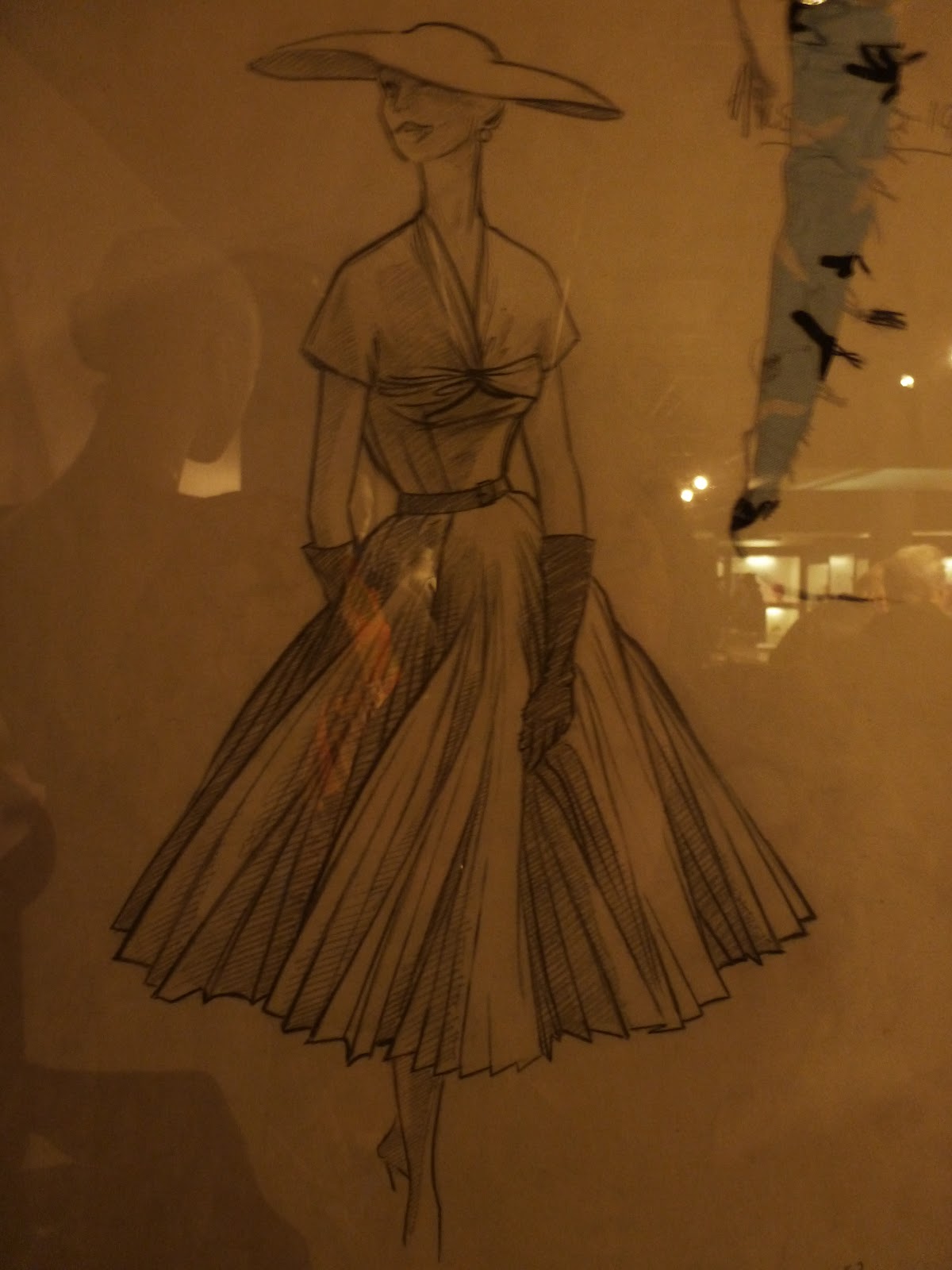
Dotted throughout the exhibition were sketches of designs by Hartnell and Amies. This are beautiful works of art, finely drawn with the detail painted in. The photographs are not brilliant but I am including a couple as I don't want to leave them out of the story.


I hope you enjoyed the tour of the exhibition.