Saturday, 6 October 2012

Mountain Maid wools 1940s jumper


I initially picked up this pattern because I loved the colours used in the picture and the fantastic hairstyles. When I looked at it more closely I realised that it featured two fabulous early 1940s jumper patterns. The green one is called 'ribbed sweater with fancy yoke' and the red one is called 'jumper in fancy stitch'. I like that a lot, not much detail given but 'fancy' conjures up a good image.

I seem to have managed to expand the width of this poor woman when I took the picture! I was just trying to get a close up that showed the fancy yoke and the jumper as a whole.

I love knitting from vintage patterns, especially those from the 1940s and 1950s so when I was asked to knit this jumper I was really pleased and excited. Knitting from vintage patterns can be an interesting journey as they often assume a certain level of knowledge, use techniques or stitches that are no longer common and often do not write out the full instructions, leading to a certain amount of educated guesswork! However, this is what makes it interesting. Also, nothing beats a hand knitted jumper which keeps as close to the original pattern as possible if you are after an authentic vintage look.

The jumper pattern is written for 3-ply wool for a 34-36 inch bust. I needed to knit it in a marginally larger bust size using a 5-ply wool from www.millamia.com. It was a gorgeous bright red and lovely, soft merino so it was really a pleasure to knit with. Because of the change both in size and weight of yarn I had to knit up a number of tension squares on a range of needle sizes to be sure that the jumper would come out correctly. If you are changing between a 3-ply and 5-ply (or other wool weights) you need to remember that it will change the look or feel or both of the garment from how it was originally intended. Using the 5-ply for this pattern has produced a very dense, close rib, especially as I had to use very small needles (vintage14s) for much of the rib. In the 3-ply it would have come out as a finer looking, lighter rib.


The completed back showing back opening.
The back opening is closed with four buttons. A row of single crochet
is worked down one side and loops are made to fasten the buttons.


The jumper looks really tiny which caused the odd panic but as it is a purl 2, knit 2 rib it has a fantastic amount of stretch! A friend kindly gave me a crochet lesson so that I could manage the back fastenings. It has definitely put crochet on my crafts to learn list.


The front, showing the armhole shaping.
A close up of the fancy yoke!
The sleeves were very interesting to knit and construct as they had shaping that is quite different to modern sleeve shaping in order to create that particular 1940s look. At the shaped end the side stitches of the centre panel are stitched to the cast off edges which lie beneath them, creating a kind of box.


The sleeves showing the shoulder and top of sleeve shaping.

As the jumper came together it was very exciting and I am really proud of the end result. It is definitely fancy and I like that!


The finished article.

Friday, 28 September 2012

My fashionable mother (and father)!

I have written about my mum's clothes from the 1970s in a previous post. I have also written about her 1960s scrapbooks. I now want to combine the two using some photos that I found when I last rummaged through my parent's photograph albums. I have chosen photos that show outfits of my mums that I love and which particularly reflect the era in which she grew up. Many of the clothes she wore as a teenager she made herself, some of the clothes of her early twenties are bought from boutiques.

This is my mum aged about 15 in the back garden of her house. The trousers are dark green cotton and the blouse is white trycel with a frill, from the John Moore's catalogue. The shoes were her favourites, they were nice to walk in, had a tie at the front and a block heel. Two things stand out in particular for me in this photo. The blazer pulls the outfit together and it made me laugh to find that it is my mum's oldest sisters. It is the blazer of Bridlington Girl's Grammar and was dark green with white and black stripes. Then the sunglasses, mum looks so cool but they can't have been needed in Lincolnshire!

I love this picture even though the detail is hard to see as it has been double exposed. I couldn't find any single pictures of either of the outfits featured. Mum is about 16. The pale green coat is from a Petticoat magazine pattern offer, the material arrived cut out and ready to sew. It was herringbone tweed, fairly straight up and down, long sleeved and had a front zip with a big ring pull a la Mary Quant. Mum's main comment was that it was itchy!

The second outfit is brown, shiny, single breasted coat. It was made of a new fabric which was a foam backed cotton/rayon. I think that sounds strange but mum said that it draped well as it was heavy, it was warm and it was showerproof. This coat was not handmade but the red baker boy cap was, out of some old clothes, a good example of recycling!


Mum made this green suit in 1967 from a Petticoat magazine pattern. You sent away for the basic pattern and then every week in the magazine it showed you how to adapt that pattern in different ways. For example, to change basic sleeves to puff sleeves, to add epaulets to make a military dress or to change from a round to a v neck. It was like having pattern cutting lessons and helped mum expand her dressmaking techniques. At junior school she had learnt how to sew simple gathered skirts, blouses and some embroidery.

Trouser suits had just become fashionable with thin legged trousers and a Mod length coat. You can see the influence of The Beatles in this and in the John Lennon sunglasses.


This is mum aged 18 in her favourite dress; it is navy and white patchwork knitted trycel. The bodice is sheared to the waist and the sleeves are sheared above the elbow and tie at the wrist. Mum has paired it with navy shoes and hat. It was bought from a Mod shop in her hometown and she wore it when she was at college and at work in London. I commented on the length of the dress when I found it, I don't think I would have been allowed out in it! Mum said she hadn't thought about the length until one day half way up the stairs to the top deck of a London bus!


This is mum in Hyde Park in 1971 just after doing her A levels. She was staying with a friend. This dress is handmade; it is cotton polyester with a pink paisley on a white background print, bought in Eve and Ranshaw in Louth, Lincolnshire. The dress was cut in one piece and was slightly A line. It has puffed sleeves, a V neck and a zip up the back. Mum's shoes are grey snakeskin sandals from Clarks.


I love this outfit of mums from when she was at college, it is 1972. The photo was taken in Greenwich Park which mum and dad visited via a boat trip on the Thames from Westminster. The trousers are from Topshop; blue bell bottoms printed with white stars. Although you can't see her top mum remembers that it was a red t-shirt with blue star shaped buttons. Her shoes are blue patent clogs, it is so wonderfully co-ordinated!

The clogs almost got mum into trouble. When at college she could not afford the halls of residence so lodged with some other girls in the nun's wing of a convent! Curfew was 11pm, one day mum just made it before the door was locked and ran down the corridor to her room, clogs banging away on the floor. The next day at breakfast Sister Patricia spoke at length about the noise and the seriousness of almost being late in. After that mum ran down the corridor in her socks!

Mum made her coat by cutting down a big black sealskin coat of her Nanas. Nana used to demonstrate ballroom dancing at The Pavilion in a park in Sheffield. She wore the coat over her dancing clothes. Mum lined it with brown and gold brocade which came from old curtains. It fastened with a large press stud.


Mum made this dress; she bought the material at Peter Jones; it is purple cotton with a white pattern. It is
1972 and maxi dresses were beginning to come in. The dress had a tight bodice and sleeves with an A line skirt and a tie at the back. I like this photo as it shows mum dressed up to go out and celebrate my dad's 21st birthday. She also remembers that it was just after Lady Chatterley's Lover had had the ban on it lifted.


This was taken in Hubbard's Hills, Louth in 1973 on the way to a wedding. The dress is from Bus Stop, a boutique in Kensington Church Street London. It was one of the places to go and shop, it had communal changing rooms (horrors) which were a new idea. The material is dark red, dark blue and cream Indian paisley on cotton lawn. It fitted very closely over the ribcage a la Biba. I have shown it in the 'inside my mother's wardrobe post'.

Itis time to feature dad! It was much harder to get memories about his clothing from him but I did get a few facts. I love the colour combinations here. It is 1973, the shirt is skinny fit with a long collar. The tank top is Lord John and is maroon and white stripes. The jacket that can just be seen is part of a tweed wide lapel suit.

I couldn't find out why dad looks so puzzled! I picked this photo because of the leather jacket which is from Lord John. It is brown leather with cloth ribbing around the waistband and the cuffs. I like it so much it has been in my wardrobe for some time!

Here it is 1974 and mum and dad are on their way to a dinner dance. Mum's dress has a knitted sliver and black top with a deep rib at the waist. The skirt is long, black and gored. Dad is in his wedding suit which is Lord John. He thinks the tank top may have been BHS.


I have included these two pictures as they show mum in clothes that are featured in my post 'inside my mothers wardrobe'. All the details on the clothing can be found there.

Thursday, 30 August 2012

Vintage haberdashery adverts.

As well as the glorious patterns for all manner of crafts in my old magazines I also really enjoy looking at the adverts. I could talk about all manner of adverts, those for reducing (in size), tampons (as they developed), custard, shoes or bleach. Perhaps one day I will as they are a fascinating insight into the way people lived, product development and the gradual evolution of ideas and ideals. Because my latest magazine haul was Needlewoman and Needlecraft I want to focus on haberdashery adverts as, obviously, that is the most fitting product to advertise in that type of magazine. Plus, I love haberdashery. It is pretty, its is functional, it is interesting and most of all it is full of potential; just waiting for you to come along, make a choice and produce something gorgeous with it.

It is worth taking a look at the Woolworth's Museum site (random I know), for its 1950s haberdashery displays http://www.woolworthsmuseum.co.uk/1950s-i-woolhaby.htm . Woolworths stores all had a large haberdashery department selling buttons, wool, knitting and sewing patterns. The site has pictures of these plus pictures of store windows showing a display for wool week or for making do and mending.

I think this is brilliant. The bonkers curtains, the lovely
colours, the shapes, her beautiful dress and hair.

I like Anchor adverts. Great colours again and a fancy
cross stitch tablecloth is always good.

I'm not convinced that she would do her own mending
but she does lend an air of glamour to the proceedings.

Same with her, I think the wonderful hair and make-up
would not leave enough time to personalise her dainties
with embroidery. I think a maid is lurking in the background.

What a fabulous display of threads. Spoilt for choice!

Janet, Alison and Enid. All three of them give great jumper.
And hair.
Enid is 'striking the happy medium between primness and
frivolity'.
Alison is 'all for cosiness so this long sleeved style is more
suitable for me'.
Janet says ' how do you like the bright little idea I'm wearing
now?'

Wool snake. Wool snake charmer. Magic carpet.
Great colours. Can't beat it!

Showing you the 'smartest ways of using the best bias
binding of all'.

I would like to think that she is called Melody as well
as the wool. I love the cardi, I'm not sure I will ever
have the patience to make it.

'These little folk are happy all day long, at the seaside,
in bathing suits of Crocus wool. They are warm and
comfortable and do not shrink or loose their shape'.

Featuring a' backless suit for sunbathers, a fancy
pattern for two bright colours and knickers and
a brassiere to make a novel two piece bathing suit'.

Colour. Beautiful.

Good to have a reliable zip for all situations.

Excellent. Women can crochet and be intelligent. Quite
progressive.

Little boxes of colourful delights.

Anchor had to feature an anchor at some point really.

I agree that the women have glamour.
The thread though?

Lovely embroidered tea cosy.

Nice to see how the transfer and stitching work.

I realised that I have had my own small connection to haberdashery for many years as I went to school in London at Haberdashers' Aske's Hatcham Girl's School. It was the longest name of a school in the country at the time but it has changed name now. Whilst it sounds ever so posh it wasn't at all, the name is due to the founder of the school, a Robert Aske, who was a Haberdasher. In 1689 he died and left £20,000 to the Worshipful Company of Haberdashers (of which he was a member), to buy land and build a school. The Haberdashers were founded in medieval times by a group of traders who all lived in the same place in London and all worshipped at St. Paul's Cathedral. They sold ribbons, pins, gloves, purses and beads and were joined by the Hatmakers in 1502. They were like the trading standards of the day in charge of checking quality, training apprentices and setting wages amongst other things. They controlled the haberdashery trade in London until 1650 when the population of London grew too large for it to be practical. They now exist as a City of London Livery Company and concentrate on education and charity work.

Monday, 27 August 2012

Latest vintage magazine finds.

When I go out and about I am always on the lookout for charity shops, antique centres, vintage fairs and quirky little places where I might find some treasure! Most often I look on my own as the people I am with tend not to have the same capacity or desire to sift through piles of 'junk' - as they see it! So each to their own, I have a very happy time! In the Lake District last week I stumbled across a mini treasure trove. I expected my week to be full of walking, looking at beautiful mountains and trying various tea and cake establishments. All of that happened too, but the randomness of my find added to the delight of finding it! I think I let out a little squeal when I found a pile of Needlewoman magazines from the 1930s and some Needlewoman and Needlecraft magazines from the 1950s.

I love old craft magazines for a variety of reasons. Obviously they are a marvellous source of patterns for garments from past eras. Most of them have knitting patterns and I have found some beautiful jumpers and cardigans to put on my list of things to make. I like seeing the ideas for household items, it gives a real sense of what a period home would have looked like. Sometimes I am amazed at the array of embroidered tablecloths, chair backs, table runners, place mats, napkins, stools, firescreens and pictures. I wonder how anyone had time to produce such things. I enjoy the physical feel of something old in my hands. I like to think about the previous owner - what did they make out of it?, what did they wear?, where did they live?, what was their house like?, what have they lived through? I particularly like the connection that is made when the magazine has a surname and address on the back, for a subscription delivery.

The following pictures are of the front cover of each of the magazines, starting with the oldest. From these alone I think that you get a real feel for the wealth of needlecraft projects contained within, from embroidery to crochet to tapestry to knitting to cross stitch to applique.

Highlights the free transfer available in this issue,
featuring 'four lovely little flower sprays arranged in a
surrounding border of single Forget-Me-Not
flowers'. The suggested use is for a drawing room or
boudoir blotter cover.

This cover features the design for a cushion that
is part of a garden tea set. Other ideas in the set are
a firescreen, a pouffe, a tea cosy, a chair back and
a table runner.

A bowl or roses in cross stitch - 'a beautiful theme in
a favourite stitch, rich and luxurious to behold'.

An embroidered wall panel.

An applique market scene.

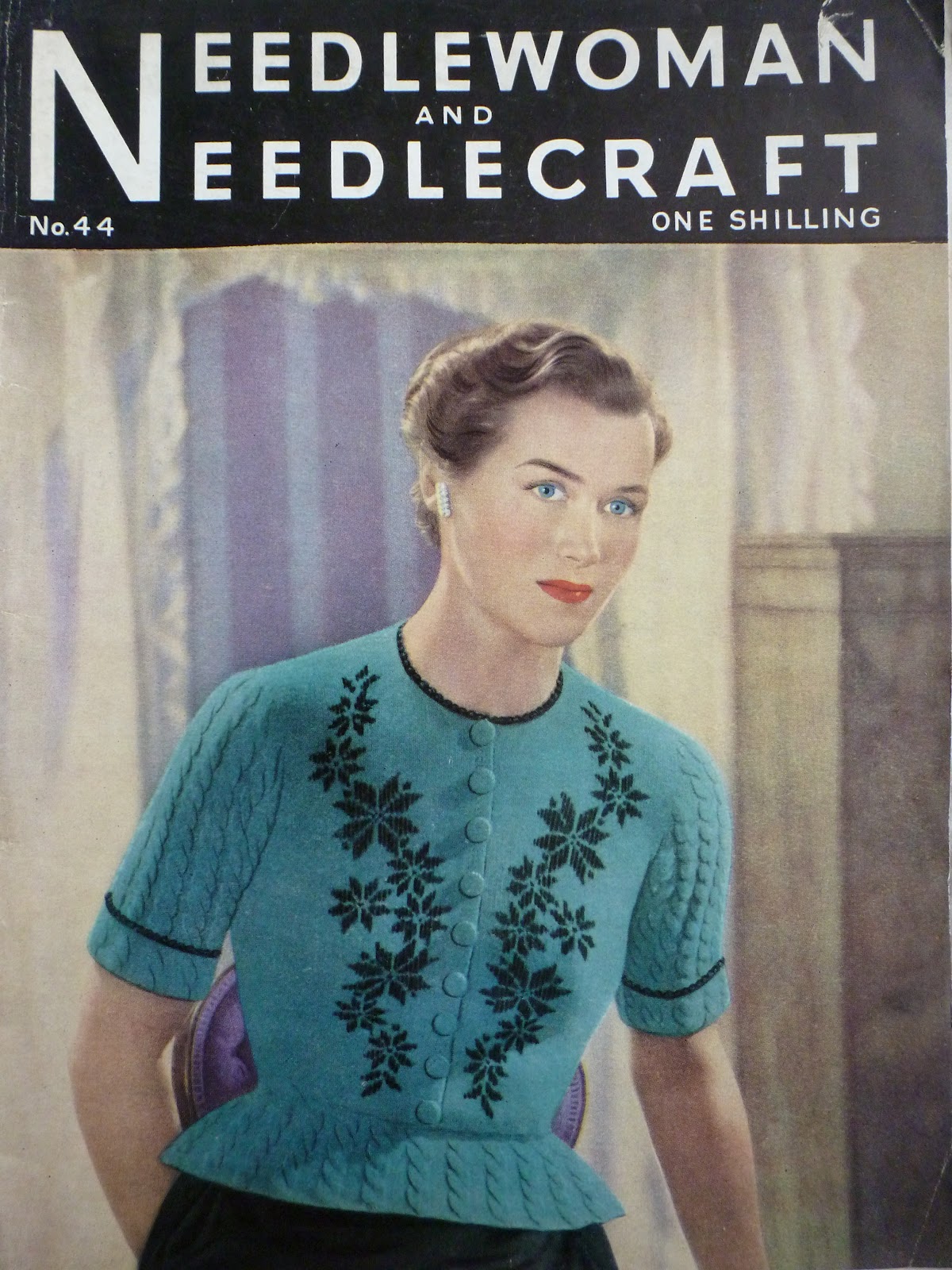
The most beautiful cable and fair isle peplum jumper.

An applique bowl full of silk embroidered anemones.

'Like all good traditional designs, Jacobean embroidery is
very pleasing to every generation and it is perfectly
suitable in our modern home'.

A firescreen featuring a 'distinctive design with a quiet
blending of colour reminiscent of the English designs
of the Regency period'.

An autumnal luncheon set of six, featuring oak, elm,
mountain ash, beech, chestnut and sycamore leaves.

An embroidered Kentish scene.

Cross stitch design for chair and settee backs.

Embroidered spring posy tablecloth.

Alpine beauty picture - to 'retain your happy holiday
memories'.
These magazines have an interesting background. Needlecraft was first published in 1904 by Manchester School of Embroidery. In October 1907 it had a change of title to Needlecraft Practical Journal. In 1940 this title amalgamated with The Needlewoman magazine. This had been running since 1919 and continued until 1940. At this point the title became Needlewoman and Needlecraft. It changed back to Needlewoman in 1970 and then was incorporated into Stitchcraft magazine in 1977. Throughout all its name changes the magazine continued to feature a huge array of needlecraft patterns, tips and ideas. The magazines also changed size, particularly during the Second World War to account for paper shortages.