Tuesday, 26 June 2012

Fashion Scrapbooks: 1966-1967

Lately I have been looking through fashion magazines and thinking about the fashion shoot spreads showing current and upcoming trends. I started to think about all the effort that must go into producing these shoots and how carefully the clothes are chosen and styled. Someone has spent time deciding what story to tell and how to tell it. Even when I dislike the clothes or think they are not my style I appreciate the fabulous images. Some of the photographs are really beautiful yet most of the time I read the magazine, look at the clothes, pass the magazine on and think little more about it. Its almost as if the pictures go to waste and sometimes I think I should save my favourites but then what would I do with them?

Then I remembered that my mum has a stack of scrapbooks that she made as a teenager in the 1960s and I used to be fascinated by all the pictures. They are an amazing piece of fashion history, composed of photographs and drawings from magazines. I dug them out on a recent visit and asked her to tell me more about them.

In 1966 a new magazine was created for teenagers called Petticoat which aimed to showcase current fashions. In 1967 Janet Street-Porter was appointed editor, she had close links to the designer Zandra Rhodes amongst others. Mum started to get this magazine for the fashion and also because it offered sewing patterns. Mum was keen on sewing and knew that it was the best way to get a wardrobe of new outfits in styles and fabrics that she wanted as money was tight. She also read Honey magazine and the Sunday Times magazine (launched in 1962), which was good for fashion illustrations. Mum used the Sunday Times magazine as the base for her scrapbooks, cutting pictures out of other magazines, choosing themes and layouts and sticking them in. She wanted outfits that were high fashion and reflected current trends but they also had to be things that she liked and wanted to wear. Mum remembers that everyone wanted to look like Twiggy at that time and that close attention was paid to hemlines which were religiously copied much more so than today.

I'm concentrating on the scrapbooks from1966 and 1967 and will feature others in a future post. I have chosen the images that particularly interest me, there are many others.


Front cover of 1966 scrapbook.
Chosen as links to Vidal Sassoon and asymmetric style.

Pop art. PVC is a new material for making clothing.


Hair styles and hats.
Asymmetric sharp bobs and pill boxes.

From Petticoat magazine.
Mum made a green kilt form their pattern.
Her sister knitted her a dark green fitted top.
She wore it with an old navy blue beret.

Shirt dresses were coming into fashion.
Printed needle cord was a new fabric.
Crochet beanie berets were popular.

Front cover of 1967 scrapbook.
Shirt dresses and kipper ties.
Eye make-up progressed from Twiggy lashes to making
the corner of the eye look turned down using make-up.

Mary Quant advert with berets and toning tights.
Before tights were invented in 1959 stockings were worn.
The mini skirt launched in 1965 and tights became popular.
Coloured tights were just coming in.
Mary Quant wanted these tights to complete her look of
head-to-toe streamlined simplicity.

This range of raincoats tied in with the styling of the film Bonnie and Clyde
featuring Faye Dunnaway and Warren Beatty which came out in 1967.
The drawing reflects the style of Aubrey Beardsley (1872-1898).
 He became popular again in 1967, possibly due to the Sexual Offence Act
decriminalising homosexual acts between two men over the age of 21.

If you did not wear tights with your short dress you could wear
knickerbockers and stockings.
Mum had a dress with matching knickerbockers in a white cotton
with a print of yellow flowers with green leaves. It had puff sleeves,
a gathered skirt and a bodice shirred in green.
She wore it with lime green stockings.
Mum wore this on a river boat dance organised by the youth club.
The boat was the Tattershall Castle and Waterloo Sunset by The Kinks and
A Whiter Shade of Pale by Procul Harum were played. 

Once women reached 16 they were expected to wear a girdle.
In 1958 Lycra was invented as a replacement for rubber corsetry.
It became more widely available in the 1960s and was used to make
underwear more lightweight.

A Petticoat magazine spread featuring some knickerbocker dresses.

A range of shoes, all with a good height heel so they were comfortable
for walking.
White tights were beginning to become popular.

Dresses from Petticoat magazine with fitted tops and gored skirts,
 matched with colourful shoes.
Mum had one in turquoise and cream herringbone wool which buttoned
up the front and had a pointy collar.
It came from Topshop.

Wedding dresses.

Sunday, 3 June 2012

Inside my Mother's wardrobe

Now, I should probably start by saying that whilst my mum wears lovely clothes and is perfectly stylish it is not her current wardrobe that I wish to talk about. I want to focus on part of her wardrobe from the early 1970s, when she was in her early 20s and had moved from a small rural town down to London.

I would have liked to know my mum as a teenager. From old photographs I can see that she was fashionable - hair in the latest style, on trend clothes, fancy shoes. Like many people who didn't have lots of money to spend on their appearance my mum made many of her clothes. I have heard stories of many of the dresses and seen photos (which I can't post here until I've asked her if she would mind)! If she agrees I will follow up this post with more pictures. I love the fact that she sat and looked through fashion magazines and browsed in shops for inspiration and then just went home and made it herself. She has a collection of Golden Hand magazines which we have looked through together discussing what she made. I bought one from a charity shop a few weeks ago which featured a Vogue wedding dress pattern. This turned out to be the pattern she used to make her own wedding dress!

Mum has recently decided to part with some of her clothes from the 70s. Both my sister and I would love to wear them but there is one small (literally) snag. Mum was clearly absolutely tiny, one of her skirts will not quite do up around my thigh and where her rib cage used to go I really don't know! I have tried to take pictures of a high quality but am hampered by the fact that no one I know can fit the clothes to model them and I don't have a dressmaker's dummy to display them on either. I still think they are worth a look.

Stirling Cooper two-piece, floral print on black.
Shirt shoulders gather and tie.
Skirt has shirred front panel and ties at the sides.
Fabulous red buttons.
Bought in 1976/7.
Mum wore this whilst pregnant with me!


 Halter neck bandeau top and floral and pink denim panelled skirt.
Handmade by mum in 1974/5.
Worn to many parties and dances on river boats on the Thames. 


Close up of the floral fabric.


Long sleeve tie front dress .
Bought from Wallis in Oxford Street in 1976.

 Close up of the fabric, a mixture of ditsy florals, paisley and folk print.


 Orange wheat ear brocade dress by Eastex.
This is actually a 1960s dress which Mum bought in the 1990s.
I had to include it as it is beautiful.


A close up of the amazing buttons and embroidery.
I love this fabric, I wish this dress fitted!


 Red squiggle chiffon floor length dress.
Bought in a boutique off Victoria Street, London, in late 1976.


Close up of the fabric.
It is sheer so Mum made a long red slip to go under it.
She wore this whilst 3 months pregnant with me!


Mum wore this dress to The Royal Marsden charity fund raising ball at Quaglinos in London's West End. The cabaret artist was singer/comedienne Joan Turner who was a little worse for wear and not on top form. Several men began a protest by getting under their tables, lifting them above their heads and advancing on the artist. During this bread rolls started flying towards the stage. An appeal for order was made by Danny La Rue and Ava Gardiner who managed to rescue Joan Turner!

One of the things I love about vintage clothes is the idea of the life they may have led before they became part of mine. I always imagine the type of woman who owned my dress before and the events and occasions they would have been to together. I love that tangible link with history. Its a shame the garments can not speak and tell all their tales. This is one of the reasons I am so interested in my mum's clothes as she can tell me all about them.

Tuesday, 29 May 2012

Vintage knits with Handmade by Kate-Em

I love to knit. It makes me happy and relaxed. I love starting with a gorgeous ball of yarn and ending up with a beautiful garment. I can be found knitting most of the time, even when I am supposed to be doing something else. I also love vintage clothes, particularly those from the 1940s and 1950s. I like the elegance, the cut and fit, the fabrics, the quality and the attention to detail. I enjoy the glamour, the hairstyles, the make up and the accessorising. A while ago I realised that I could combine both these loves into one fabulous, enjoyable, exciting experience. I decided to make good use of my collection of vintage knitting patterns and started to make up the garments. I try to keep as close to the original pattern as possible, using the correct weight of wool and needle size. If colours are suggested I often try to use them, to see what the garment would have looked like to the person who designed it.

At present, I make what I love to sell at vintage fairs and I also knit to order. It is wonderful to see the old patterns come to life and I thought you may like to see them too. My mum also enjoys making from vintage patterns so some of the items are made by her, especially the crocheted ones.

On Sunday I had a stall at Halifax Vintage Extravaganza. The following pictures are of items I had there.

You might recognise these from my previous post.
 They make a gorgeous colourful bouquet.
Displayed in a cut glass dish from a charity shop.

The stall in full.
Notice I have used a carnation as an accessory and to hide my belt buckle!

A 1950's petal cap.
Each petal is knitted individually then sewn together.
It is worn towards the back of the head and pinned in place.

The green pom pom hat, you can see it is in the original colourway.
From the 1940s.
Best worn at a jaunty angle.
Handmade by my mum!

1940's moss stitch turbans.
There is a cap part that sits at the back of the head.
The long strand is then twisted to form a knot and looped over the cap to secure it.
A 1940's leaf beaded leaf band and matching beaded bag.
In cream, it would suit a vintage bride.
Handmade by my mum.

Several leaf bands and a gorgeous beaded snood.
The cabled scarf is a 1940's lady's cravat.
The gold hat is a 1950's Juliet cap.

A 1940's cable edge cap.
Also to be worn at a jaunty angle.
Lined with vintage Chinese brocade from my great auntie's curtains!
Handmade by my mum.
Look out for more vintage knits in future posts.

Monday, 21 May 2012

How to make a 1940s floral accessory

Recently I had a craft day with a friend. Sometimes it is great to craft on your own as your mind is free to roam and be creative. But, I also enjoy crafting with others - its sociable, you can exchange ideas, swap techniques, add moral support or cups of tea through disasters and you get to be nosey and see what others are making. My friend made lots of beautiful items for her home - storage bags and boxes, a table runner and cushions.

I was inspired by a 1940s pattern that I have for leather accessories. It features a bag, cap, purse and a gorgeous carnation. I was thinking about how 1940's women always accessorised their outfits well, often out of necessity as buying new was not always an option. So I decided to make some carnations to brighten up dresses, cardigans, hats, bags, as buttonholes or perhaps just to put in a jug on my desk. I have used felt, as women at that time often did.

On plain paper I drew 2 grids, one 2" by 3" and one 3" by 4". I have used inches as I wanted to make my flower to its original dimensions. I used these grids as a guide to draw my petal and calyx templates. You could draw these by hand and could also change the shape and size.


Once cut out I pinned each pattern piece to the felt. Each carnation needs one calyx and 12 petals. I cut round the template rather than draw round it so that no marks would be on show on the finished carnation. I used pinking shears round the petal top as carnations look a bit feathery, you could also cut a fringe or leave it plain.
Next, take one petal and roll it into a tube. I secured it at the bottom with a few stitches. Then cut 2 petals in half leaving a join at the bottom. Position these around the tube and stitch in place when you are happy with the result.


The next stage is trial and error as this gives the final shape of your flower. The petals need to be added one by one, keep checking to see that you like the shape that you are producing. You can hold them together or add a couple of stitches every few petals.


Leaving 5cm free at each end I then tightly wound a 36cm length of florist's wire around the base of the flower. You can rearrange your petals as you do so.


Twist the ends of the wire together to form a short stem. Position the calyx so that it covers the bottom third of the petals and all of the wire stem. The calyx piece needs to be tightly wrapped around the stem. I used a dot of glue to attach the calyx to the petals, then stitched it down the stem. You could also cut a leaf shape from the felt and stitch it to the stem.

That's it! One carnation made. Now all you need to do is decide what to do with it!


Friday, 18 May 2012

Britannica 1951-1953 exhibition

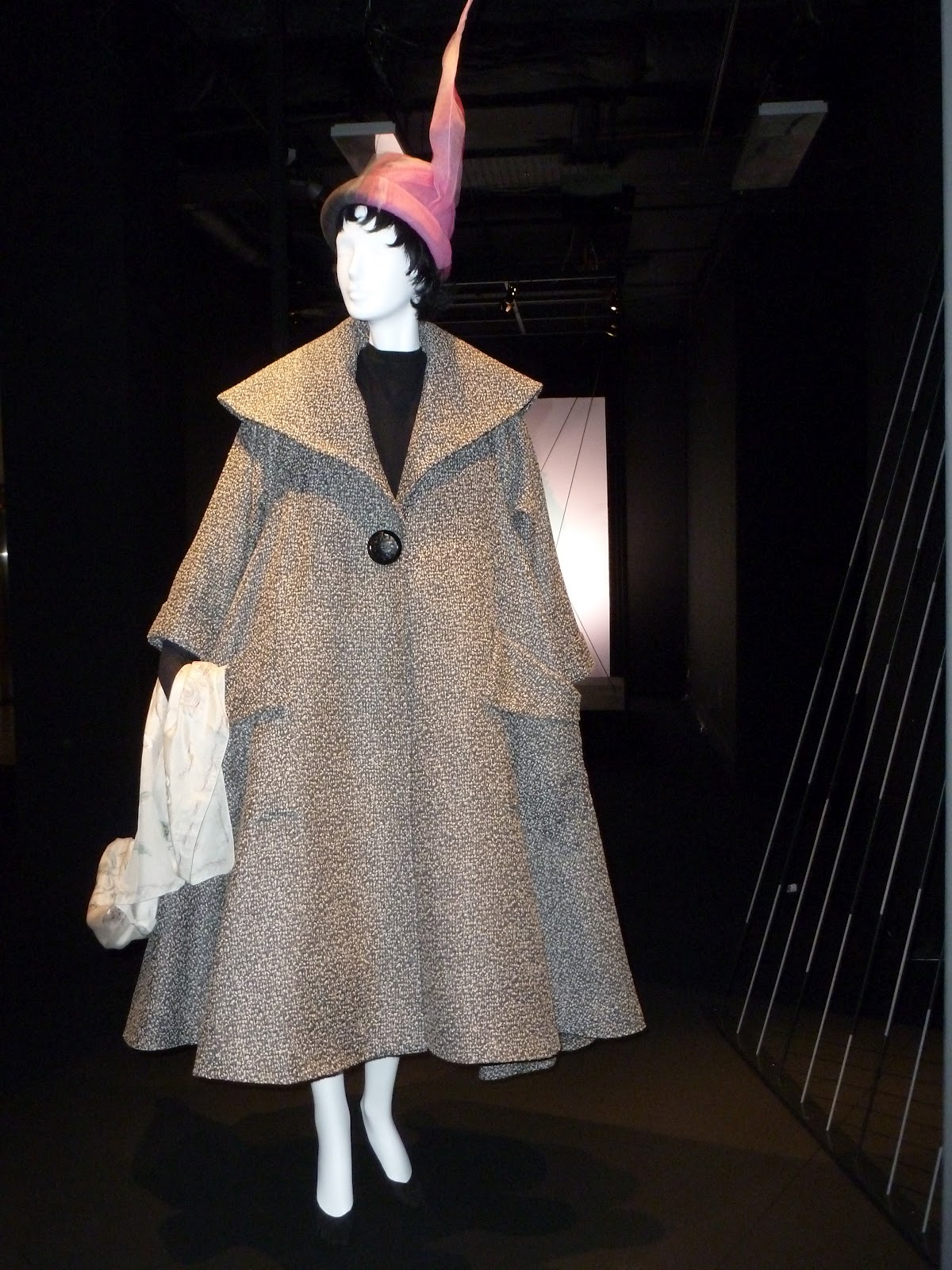
Whilst in London recently I made a special trip to Selfridges to see the Britannica exhibition. It is part of the Jubilee celebrations but I wanted to see it as I love 1950's clothes, the dresses in particular. In February 1951 Vogue produced an issue celebrating post-war British culture and style. They followed this up with two further February issues in 1952 and 1953. These covered the period from the Festival of Britain to the Coronation. The exhibition is based on clothes from these issues.

There are only 7 exhibits but the clothes are fantastic and well worth a look. It is perhaps important to remember that women would have bought some of these outfits as patterns and made the clothes themselves. The millinery is modern and has been made by Stephen Jones to complement the outfits. Obviously they would have been beautifully accessorised at the time as such 1950s outfits were. The exhibits are set up round a central clock; this gives the idea of how a woman may have changed outfits throughout the day, ready for any occasion.


Late day dress with circular skirt.

Beautiful shoulder detail, great corsage.


'Easy to make' wide skirted dress


Detail on dress - crowns and thistles.


Slim suit with curved pockets and back pleated skirt.


Flared coat with deep cape collar.


Silk scarf details, elegantly draped over coat.


Casual outfit - plaid circle skirt and fitted top.


Detail of fitted top and impressive headpiece.


Evening dress with strapless bodice.


Large net bow and feather headpiece.


Close up of beading on the bodice.


Casual outfit for the countryside.


Beautiful sequinned headscarf
It is perhaps important to remember that women would have bought some of these outfits as patterns and made the clothes themselves.